International Commercial Arbitration Q3 2026

This update explores trends and developments in international commercial arbitration from a Norwegian perspective – together with our views.
We first look at the newly published «PO2» in the Heroic Idun case regarding the handling of complex questions in respect of requests to produce (alleged) confidential documents from a London arbitration. Second, we comment on a fresh decision from Oslo District Court regarding arbitrators’ independence and impartiality in cases of repeated appointments. Third, we highlight news from Q3 2026 – where we, among other things, celebrate the choice of NOMA Arbitration as the default dispute mechanism under the newly updated Nordic Marine Insurance Plan.
We round off with an overview of events you may consider including in your calendar this upcoming winter.
Heroic Idun-PO2 – Document request and (alleged) confidentiality obligations in London arbitration
Overview
The issue in the Heroic Idun case was a claim for cover under a war risks insurance pursuant to the Nordic Marine Insurance Plan. The award is available here . In our Q2 2026 Newsletter, we analysed and commented on the PO1 from that case. NOMA has now published the second procedural order from the Heroic Idun case («HI-PO2«), available here.
The situation in the Heroic Idun case was that the Claimant (Owner) was also involved in a LMAA arbitration seated in London (the London Arbitration) against the time charterers (Mercuria). In the London Arbitration, Mercuria had submitted pleadings, documents and expert reports that would not otherwise have been available to the Owner (the Mercuria Documents). The Respondent (war insurers) in the Heroic Idun case, made document requests relating to the Mercuria Documents. The Claimant disputed these requests on the basis of (alleged) confidentiality obligations in the London Arbitration.
The main issue dealt with in the HI-PO2 was:
Can the Arbitral Tribunal order the Claimant to produce evidence produced by Mercuria in the London Arbitration?
Following an in-depth legal assessment, the Arbitral Tribunal in the Heroic Idun case concluded that it might order such document production if the document request meets the fundamental requirements of sufficient specification, relevance to the case and materiality to its outcome. In the following we will take a closer look at the different aspects of this decision.
The general fundamental requirements for document requests
In the Heroic Idun case it was clarified in PO1 that «the Tribunal shall seek guidance in, but is not bound by, the NOMA Rules on the Taking of Evidence». Based on these provisions, the Arbitral Tribunal set out the general fundamental requirements when ruling on the requests regarding specification, relevance and «materiality», see HI-PO2 paragraphs 9 – 13. We will not go further into these requirements here.
Note that as of June 2025, the NOMA Best Practice Guidelines Article 10.2 refers to the IBA Rules On The Taking of Evidence 2020 (IBA Rules 2020) instead of the separate NOMA Rules on The Taking of Evidence (which was based on the IBA rules). See more on the basis for this shift here, which in practice does not imply any material change. Consequently, we believe that the result in the HI-PO2 would have been the same had the IBA Rules 2020 alone been used as a guidance.
As already mentioned, the main issue in the HI-PO2 was whether (alleged) confidentiality obligations in relation to the Mercuria Documents could «block» the Respondent’s document requests.
A thorough review of both parties’ submissions and the Arbitral Tribunal’s assessment and interpretations would go far beyond the scope of this newsletter. All readers interested in international arbitration are urged to read this procedural order carefully. Below we will highlight three important takeaways.
Takeaway no. 1: «Gap-filling» in Norwegian-seated international arbitration
When arguing its positions – both parties referred to the Norwegian Dispute Act as a mean for «gap-filling». To this the Arbitral Tribunal stated the following in paragraph 19:
«However, because the present arbitration is an international arbitration, the Arbitral Tribunal is reluctant to rely on the Norwegian Dispute Act as a mean for «gap-filling» by analogy or as a source for guiding principles; in particular in an international arbitration governed by the NOMA Rules (Cf. Bjøranger Tørum, Norsk ad hoc voldgift i en brytningstid, Tidskrift for Forretningsjuss, 2017, pp. 77-80).»
We agree with this statement, and the principle also follows from e.g. HR-2017-1932-A (MAN) where the Supreme Court used international best practice in the interpretation (see e.g. (87) and (115)) and made the following general comment (114):
«It also seems to be in line with an international arbitration trend that these issues are resolved based on what one may refer to as a «denationalised approach» and freer deliberations regarding the parties’ common qualifications and fair expectations. I refer to Blessing, The Law Applicable to the Arbitration Clause, from the collection Improving the Efficiency of Arbitration Agreements and Awards: 40 Years of Application of the New York Convention, 1999, pages 168-188. Blessing mentions that the question to which extent an arbitration agreement is binding on other parties than those immediately bound by it, is often subjected to a «denationalised approach», which has also partially influenced the parties’ litigation before the Supreme Court to the extent Norwegian law has not been applied. Under any circumstances, Norwegian judges’ view on which conclusions can be drawn from such a «denationalised approach», will to some extent be coloured by habitual Norwegian legal approach.»
This was also followed up by the Supreme Court in HR-2023-573-A (45) (for more on this case see our Q1 2023 Newsletter:
Finally, I mention that the Arbitration Act is based on the UN organisation UNCITRAL’s Model Law for international arbitration. The purpose of the Model Law is to contribute to the harmonisation of national rules. If there is doubt about the interpretation of the Norwegian Arbitration Act, the solution in other countries whose legislation is based on the UNCITRAL model could therefore provide guidance for the interpretation of the Arbitration Act. The Model Law in itself does not regulate the issue at hand, and the solutions used as a basis in other jurisdictions having based its legislation on the Model Law have only to a limited extent been presented to the Supreme Court. However, the materials provided give no reason to believe that the result I have reached is contrary to international consensus.»
Based on this, the first important takeaway from the HI-PO2 is general and relevant for all Norwegian international arbitrations: «Gap-filling» should draw on legal sources relevant to establishing international best practice in international arbitration – rather than the Norwegian Dispute Act. This, in turn, implies that counsels in international arbitration must also be familiar with these legal sources.
Takeaway no. 2: IBA Article 3.13 the appropriate starting point – not English law
A difficult question for the Arbitral Tribunal was which starting point to adopt when considering the request to produce the Mercuria Documents from the London Arbitration. The options were, on the one hand, English law on confidentiality in arbitration and, on the other, a «lex arbitri» approach with «gap-filling» in line with Takeaway no. 1 above.
This choice was not obvious, but after a thorough discussion in paragraphs 19 – 35, the Tribunal concluded as follows (see paragraph 28):
«[…], the Arbitral Tribunal considers Article 3.13 of the IBA Rules to be a more appropriate staring point in the present arbitration case than English law on confidentiality in arbitration.»
Article 3.13 of the IBA Rules 2020 reads:
«Any Document submitted or produced by a Party or non-Party in the arbitration and not otherwise in the public domain shall be kept confidential by the Arbitral Tribunal and the other Parties, and shall be used only in connection with the arbitration. This requirement shall apply except and to the extent that disclosure may be required of a Party to fulfil a legal duty, protect or pursue a legal right, or enforce or challenge an award in bona fide legal proceedings before a state court or other judicial authority. The Arbitral Tribunal may issue orders to set forth the terms of this confidentiality. This requirement shall be without prejudice to all other obligations of confidentiality in the arbitration.»
Considering that Article 3.13 does not deal directly with the question at hand but regulates the scope of confidentiality applicable to documents submitted in each arbitration case, the conclusion above may at first appear somewhat «creative».
However, and without going into the details of the legal sources and arguments relied on by the Arbitral Tribunal, we agree that Article 3.13 provides a valid starting point. Because, using Article 3.13 as its starting point and applying exceptions from confidentiality set out in that provision, the Arbitral Tribunal arrived at the following guiding legal principle (paragraph 40):
«Based on the above, the Arbitral Tribunal concludes that the second exception [«may be required [to] protect or pursue a legal right«], at least by way of analogy, provides guidance in the present case by showing that an internationally recognized instrument like the IBA Rules recognizes exceptions from confidentiality in arbitration and by providing guidance on the scope of such exceptions. Hence, the Arbitral Tribunal concludes that it might order Claimant to produce evidence produced by Mercuria in the London Arbitration.»
After this, the Tribunal used the general fundamental requirements for document requests (see above) of specification, relevance to the case and «materiality to its outcome». And as stated in the HI-PO2 paragraph 41: «The latter requirement of «material» to some extent overlap with «required» in the second exception in Article 3.13 of the IBA Rules.»
As views on this topic may differ, and other tribunals may consider English law to be the correct legal starting point, our takeaway no. 2 is as follows:
When considering whether to disclose documents produced in another arbitration – the starting point should be the IBA Rules (or similar rules) and not the «local law» of the «other» arbitration. This starting point will, as the Arbitral Tribunal emphasised in paragraph 29, be best in line with the expectations of the parties having agreed NOMA Arbitration and Norwegian law as lex arbitri.
Takeaway no. 3: General (valuable) assessment of «material to its outcome»
The final takeaway concerns the Arbitral Tribunal’s general observations on how the «material» test applies to three categories of Mercuria Documents. Such observations provide a welcome insight into where the bar lies with regard to document requests – both for counsel and for arbitrators.
First, the Arbitral Tribunal in the Heroic Idun case considered whether expert reports submitted in the London Arbitration were «material» to the outcome. Drawing on international legal sources and examples from procedural orders in other international arbitration cases, it concluded that expert reports from another arbitration were not «material».
Our view is that, because an expert report provides evidence relevant to the assessment of complex factual circumstances, such reports should, in principle, be considered «material» where those same complex factual circumstances are in dispute in the arbitration in which production is requested. However, as stated by the Arbitral Tribunal in the Heroic Idun case (paragraph 42): each document request must be assessed on its own merits.
Second, the Heroic Idun tribunal considered whether Mercuria’s pleading in the London Arbitration could be regarded as «material». Initially, it took the view that a pleading from another dispute should not be considered «evidence». Despite this, due to peculiar circumstances, it concluded that it could be produced in this case.
We agree with the tribunal’s general view while recognizing that specific circumstances may justify departures from the general principle.
Third, the Arbitral Tribunal in the Heroic Idun case was not averse to ordering the production of documentary evidence submitted by Mercuria in the London Arbitration – provided, of course, that the fundamental requirements (specification, relevance and «materiality») were met. In addition, the Arbitral Tribunal had the following general comment regarding the threshold for «materiality» (paragraph 46):
«Evidence may easily be «material» to the outcome of the present arbitration, even though it [is] produced as a part of another dispute. In particular if the two cases are closely related which is the situation here.»
We agree with this line of argument and consider that the general approach to the materiality threshold is consistent with the Norwegian/Nordic approach to the handling of document requests.
Summary HI-PO2: «the name of the game»
The HI-PO2 deals with complex issues, and it takes time to digest the thorough reasoning of the Arbitral Tribunal. We nevertheless highly recommend our readers to spend time with this procedural order to deepen their understanding of how international arbitrations seated in Norway work in practice. Depending on your perspective, you may disagree on some of the Tribunal’s conclusions, but that is (to use the Tribunal’s words in paragraph 23) the name of the game in international arbitration.
Overall, in our opinion, the HI-PO2 showcases Norwegian international arbitration in a very positive light, and the decision will most likely serve as inspiration for future tribunals dealing with similar matters. Moreover, it will provide a good basis for further academic research.
Oslo District Court recently considered a challenge to an award based on repeated appointments of an arbitrator by the law firm representing one of the parties
In our Q1 2024 newsletter, we reported on a survey indicating that the number of challenges to arbitration awards in the Nordic countries is relatively low and that the challenges rarely succeed. When a challenge is brought, the party seeking to set aside the award commonly argues that one or more members of the tribunal lacked independence and impartiality.
The Norwegian Arbitration Act requires arbitrators to be independent and impartial and permits an arbitrator to be challenged where there are justifiable grounds to doubt his or her independence and impartiality, see sections 13 and 15 of the Arbitration Act. These provisions are based on the UNCITRAL Model Law (1985). An arbitration award may be set aside if one or more arbitrators do not meet the Arbitration Act’s standard of independence and impartiality, see section 43 of the Arbitration Act.
As noted in our Q2 2023 newsletter, repeated appointments of an arbitrator by a party or its counsel have been the subject of considerable discussion in the international arbitration community. Such appointments may create an impression of loyalty to, or financial dependence on, the parties or law firms that have appointed the arbitrator on several occasions. The IBA Guidelines on Conflicts of Interest (2024) indicate that, depending on the circumstances, repeated appointments may give rise to justifiable doubts about an arbitrator’s impartiality or independence. On the other hand, it may be argued that the parties’ autonomy and right to appoint the best possible arbitrators should not be unduly constrained.
In a judgment issued on 29 August 2026, Oslo District Court considered a challenge to an award on the ground that an arbitrator lacked sufficient independence and impartiality because the law firm representing one of the parties had, on several occasions, contributed to the arbitrator’s appointment as an arbitrator or expert.
The challenged award concerned an insured’s claim under a P&I insurance placed with Norwegian Hull Club. Each party appointed an arbitrator, who in turn appointed the presiding arbitrator.[1] At that time, neither party objected to the tribunal’s independence and impartiality. Following the oral hearing, the tribunal decided the matter in favour of Norwegian Hull Club. The insured subsequently challenged the award.
As mentioned, the principal basis for the challenge was that the law firm representing Norwegian Hull Club had, on several occasions, contributed to the appointment of one of the arbitrators as an arbitrator or expert.
The court relied on the legal principles developed by the Supreme Court in its landmark judgment on the Arbitration Act’s standard of independence and impartiality, issued last year (HR-2025-921-A). For our comments on that judgment, please see our Q2 2025 newsletter. The overarching test under the Arbitration Act is whether there are reasonable and justifiable doubts as to the arbitrator’s impartiality. The court also noted that the objective of harmonising international arbitration law meant that international sources were relevant to the interpretation of the Arbitration Act. Accordingly, the court referred to the IBA Guidelines on Conflicts of Interest (2024) and a judgment of the Swedish Supreme Court (NJA 2010 p. 317), both of which addressed repeated appointments.
As to the facts, the court noted that, in the three years preceding the arbitrator’s appointment, the law firm representing Norwegian Hull Club had contributed to her appointment on three other occasions, which was below the threshold indicated in the IBA Guidelines. Appointments made after the award was rendered were not deemed relevant. Before the award was rendered, the law firm had also instructed the arbitrator to provide an expert opinion on one occasion and had provided her contact details to a foreign law firm seeking an expert on another occasion. She received a relatively modest fee in each case. The court observed that the fees she received for her appointments as an arbitrator were substantial and accounted for 55% of her income during those years.
However, the court reasoned that the law firm had contributed to only a limited proportion of the arbitrator’s total external commitments. During the relevant period, in addition to external board and committee appointments, she had been appointed as an arbitrator and expert in a number of cases, involving seven different law firms and eleven different parties. Furthermore, the court noted that all her previous appointments as an arbitrator had been joint appointments, which weakened the connection between her and the law firm involved in the appointments. Finally, the court observed that Norwegian Hull Club’s law firm was a large firm and that different lawyers within it had contributed to her earlier appointments. Taking all these factors into account, the court concluded that there were no reasonable and justifiable doubts as to the arbitrator’s impartiality. The judgment has been appealed.
The decision demonstrates that Norwegian courts will seek guidance from international sources when interpreting the Arbitration Act. This alignment with best practice in international commercial arbitration is welcome, as it makes arbitration proceedings in Norway more intelligible and predictable for foreign parties. It is also worth noting that the court reasoned that, because the arbitrator’s previous appointments were joint appointments, there was less reason to call her independence and impartiality into question on account of the law firm’s involvement in those appointments. This is in line with the preparatory works to the Arbitration Act, which indicate that joint appointments bolster arbitrators’ independence and impartiality and reduce their ties to the parties appointing them.
NAA News
Norwegian Arbitration Association (NAA) is responsible for the annual Norwegian Arbitration Day (NAD). The save-the-date for NAD has just been announced: 11 February 2027. Further details are available here. NAD 2027 will cover the following main topics:
- Session 1: Document production – the exceptions for privilege and business secrets
- Session 2: Preclusion of evidence submitted late
Although these topics may seem very «classical», they raise important and difficult questions.
As our review above of PO2 from Heroic Idun illustrates, dealing with alleged privilege and confidentiality across jurisdictions can be difficult in practice. It will therefore be valuable to discuss these issues in a broader context.
The preclusion of late evidence is also a «hot topic» – ref. e.g. our Q1 2026 Newsletter where we advocate stricter enforcement of deadlines (under the heading «Proposal no. 1: Front-loading – rules and stricter execution«). We thus look forward to hearing the latest thinking on this issue.
Both Wiersholm and BAHR will host pre-events the same day as NAD 2027. The main topic of Wiersholm’s pre-event is «M&A disputes in arbitration «, with special focus on the following issues:
- Earn-outs: what are the roles of counsel and experts?
- M&A claims: real buyer protection, or much ado for pennies?
You can reserve your place at Wiersholm’s pre-event here.
NOMA News
First, and most importantly, the 2027 version of the Nordic Marine Insurance Plan (the Nordic Plan) has adopted NOMA Arbitration as the default dispute mechanism for all disputes. As many of our readers will know, since 2019 NOMA arbitration has been the default jurisdiction clause where the claims leader was non-Nordic. Where the claims leader was Nordic, court jurisdiction applied by default, unless the parties had agreed to arbitration, in which case NOMA arbitration applied. Arbitration is now the default for all disputes. NOMA’s LinkedIn-post on this (see here) stated:
As many policies are with Nordic claims leaders, the shift to NOMA arbitration as the default, is thus a strong signal that NOMA is considered to be the right choice for disputes in the maritime industry going forward.
We agree, particularly given the broad representation of the maritime industry in the Nordic Plan’s standing revision committee, see here. In light of the move to NOMA arbitration in SHIP25, NOMA also seems to be well positioned for further growth as it approaches its 10-year anniversary in 2027.
Second, as noted above, we have commented on NOMA’s recent publication of PO2 in the Heroic Idun case (following the earlier publication of the award and PO1). In our view, making «real» POs from high-stakes arbitrations available for review (and scrutiny) is highly valuable for the arbitration community.
On this note we reiterate the importance of increasing the publication of arbitral awards and procedural orders (see our Q4 2024 Newsletter). Moreover, the newly established Norwegian Arbitration Association (NAA) has taken on the task of making this a reality (ref. e.g. the conversation with Knut Høvik and Borgar Høgetveit Berg in Woldgiftspodden episode 2).
Third, the final program for the NOMA Day in Bergen on 29 October 2026 has been published, see here. The main topic is «Settlements in Nordic Arbitration». We think this is an excellent choice of topic, and the detailed program looks very interesting. We hope that some elements of our proposals for «Arbitration 3.0» (see our Q1 2026 Newsletter) will be discussed during the industry debate, «We want it that way«. We will, of course, be in Bergen, and will report back in our next newsletter.
What’s On the Agenda?
BAHR and WR’s annual arbitration survey & seminar
For the fifth consecutive year, BAHR and WR conducted a survey on arbitration. This year’s main topic was What ordinary courts and arbitration can learn from each other. The findings were presented on 17 September 2026 and are available here. Our key takeaways (from an arbitration perspective) are:’
First: The survey was sent to a broad representation of people and 43 people responded. The findings should be read with this sample size in mind.
Second: Question 11 asked (translated into English): Should arbitrators to a greater extent raise the possibility of settlement early in the proceedings?
To this 69,1 % answered either «Strongly agree» or «Somewhat agree». We see this is a strong signal that the majority wants the Arbitral Tribunal to take an active role – including exploring the possibility of finding an amicable solution. This result is also in line with the findings from a survey conducted by the same firms in 2024, see our extensive report in our Q3 2024 Newsletter.
Third: Question 12 asked (translated into English): To what extent do settlement discussions with the parties impair an arbitrator’s perceived neutrality?
The results are shown below (the chart converted into English using Claude.Ai):
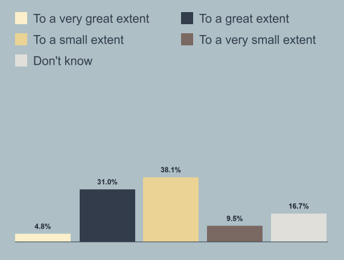
We think the wording of the question may have affected the result, because it is not clear what «settlement discussions with the parties» entails. On the one hand, the arbitrator involves themselves in settlement discussions (as a mediator), on the other, the arbitrator tries to nudge the parties towards a settlement. These two situations are very different when it comes to their potential effect on the arbitrator’s neutrality.
In any case, kudos to BAHR and Wikborg Rein for continuing to conduct surveys of this kind.
Nordics United – «stronger together» during IBA in Copenhagen
The Nordics United event took place on 7 October 2026 during the IBA in Copenhagen. The five Nordic arbitration institutions (SCC, DIA, FIA, OCC & NOMA) came together under the joint storyline «experience the power of the Nordics united«.
In previous newsletters, we have argued that the Nordic arbitration institutions would benefit from a joint «Nordic Arbitration»-story, see e.g. Q1 2025 Newsletter – under the heading «The power of a “Nordic Arbitration-story”. In this respect, the Nordic arbitration institutions’ collaboration on an event such as the one in Copenhagen is very good news.
For photographs and a short report from the event, see NOMA’s LinkedIn post here.
Danish Arbitration Association publishes a «standard PO1»
During the BAHR & Wikborg Rein event mentioned above, the Danish panellists reminded us that «Dansk Forening for Voldgift» (the Danish Arbitration Association) (DAA) had recently published a «standard PO1» («DAA Standard PO1). The first page includes the following guidance note of 25 May 2026 (translated from Danish into English using AI):
«It will, in most arbitration cases, be appropriate for the parties and the arbitral tribunal to establish more detailed rules for the arbitral proceedings with a view to ensuring a predictable, efficient and balanced handling of the case.
Set out below is a proposal for how such rules may be formulated in a Danish arbitration case. The proposal is intended as inspiration for, and the development of, a “best practice” in Danish arbitration law. The proposal both can and should be adapted to the individual case, including in relation to the parties’ wishes and expectations. At the end of the document, further topics are listed which the parties and the arbitral tribunal may consider regulating in the specific case.
It is often appropriate for a draft to be sent to the parties prior to the first preparatory meeting, so that the parties have the opportunity to discuss the draft together before the preparatory meeting, and so that the discussions at the meeting can take it as their starting point.»
We fully agree that a PO1 is an important tool in most arbitrations for securing a predictable and efficient process.
However, we disagree that it is «appropriate» to send the parties a draft PO1 before the first case management conference (CMC). In our view, for the PO1 to be effective, it must be tailored to the dispute at hand. The necessary adjustments are not fully known until the first CMC has taken place. In short, we believe the best approach is to hold the first CMC on the basis of an agenda – like the NOMA CMC-Matrix – and then prepare a draft PO1 based on the discussions that actually took place and any agreement reached between the parties.
Although the DAA Stanard PO1 is available only in Danish, it contains many good «clauses» that can be used «as is» or as starting points for amendments. So, in this respect, the document is worth reviewing for those involved in preparing draft PO1s. We nevertheless have some comments on specific points that we consider important:
Front loading
As set out in our Q2 2026 Newsletter, a front-loaded process is important to get all the cards on the table as early as possible. This applies both to the facts and the parties’ submissions.
Like the PO1 in the Heroic Idun case, DAA’s Standard PO1 is based on the principle of front-loading. However, the two procedural orders differ significantly in their approach to the parties’ submissions, document production requests and witnesses, including expert witnesses.
The Heroic Idun PO1 provides that the parties cannot submit further submissions on the merits of the dispute without the prior approval of the arbitral tribunal. This may discourage a party from holding back a submission that it could include in the statement of claim or defence, since doing so could result in preclusion. By contrast, paragraph 24 of the DAA Standard PO1 expressly states that the parties may reserve the right to exchange further written pleadings beyond those provided for in the timetable. In our view, the approach in the Heroic Idun PO1 is, as a rule, preferrable.
Document production
The DAA Standard PO1 also has a less strict framework for document production requests than the Heroic Idun PO1. The Heroic Idun PO1 provides that, to the extent possible, the parties shall include their document production requests in their two first submission. By contrast, DAA’s draft merely states that the parties shall submit their document production requests as soon as possible. In our view, firm deadlines, such as those in the Heroic Idun PO1, are preferable.
What other provisions would we have like to see?
In our Q2 2026 Newsletter , we noted that although a PO1 should always be tailored to the dispute at hand, we would have liked to see a mediation/settlement window in the procedural timetable, as well as a sealed offer mechanism. DAA’s Standard PO1 does not include such provisions, and we would recommend adding both to the draft.
Recommended listening: New episode of Dommerpodden on arbitration
Our good colleagues at Dommerpodden have released a new episode entitled: «What can the ordinary courts learn from arbitration?» (episode link here).
In this episode, hosts Ola Berg Lande and Ragnar Lindefjell speak with with Ola Nisja and Supreme Court Judge Borgar Høgetveit Berg. Although the angle is what the ordinary courts can learn from arbitration, arbitration practitioners will also benefit from the discussion of familiar topics, including the first case management conference, PO1s, front-loading, written witness statements and mediation in arbitration.
We recommend the episode. For those who do not understand Norwegian or do not have time to listen to podcasts, here is Ola Nisja’s three-point summary of what the ordinary courts should learn from arbitration:
***
There are many events to choose from on the international commercial arbitration scene. We recommend the following:
- 16 October 2026: ICC YAAF (under 40) Global Conference in London
- 29 October 2026: NOMA-Day in Bergen – see full program here
- 30 Nov – 4 December 2026: London Arbitration Week
- 11 February 2027: Norwegian Arbitration Day in Oslo – save the date (with pre-events the same day at BAHR and Wiersholm – registration here
- 1 April 2027: Nordic Commercial Arbitration Forum in Oslo – save the date
Read our previous newsletters here:
Key Contacts




Publisert: