International Commercial Arbitration Q1 2026

This update explores trends and developments in international commercial arbitration from a Norwegian perspective – together with our views.
In this first newsletter for 2026, we share our views and thoughts on the directions in which Norwegian arbitration should go to e.g. tackle the competition with the Norwegian ordinary courts (also taking into account the success rate of court-led mediation). For discussion purposes – which we hope will follow – we label the updated approach Arbitration 3.0.
We also summarise news and highlights from Q1 2026 and provide you with an overview of events to consider.
«Arbitration 3.0» – focused on solution & powered by science
Overview
In commercial disputes concerning money, the parties have, in our view, only one success criterion in common:
«a solution»
Regardless of the seriousness of the dispute, both parties seek a solution (in their favour, of course). And for the avoidance of doubt: Seeking «a solution» also includes situations in which one party (normally the defendant) drags its feet and employs «guerilla tactics» with the aim of wearing out the other party to improve its own position.
Disregarding the «solution» where a claimant drops its claim, a (civilised) solution to a commercial dispute can come in two forms:
«a settlement or a judgment/award»
With this at the forefront, we will provide our thoughts on the following question:
Is Norwegian commercial arbitration sufficiently solution-focused?
Our short answer is «no».
Given developments in the Norwegian ordinary courts in commercial contract disputes, including the success rate of court-led mediation, the fact that litigation is still being favoured over arbitration in Norway (according to Roschier’s Dispute Index 2024), and based on the scientific literature on biases and decision-making processes, it is, in our view, time for a shift in mindset and culture in Norwegian commercial arbitration. For discussion purposes (which we hope will follow), we label this updated approach «Arbitration 3.0».
In the following, we will present our views in more detail, but first; a story of development within dispute (re)solution relevant for Arbitration 3.0.
The birth of the Norwegian Dispute and Arbitration Act in 2005 – court-led mediation becoming the law
From a dispute resolution perspective, 2005 was a landmark year, marked by the enactment of two major new laws: The Norwegian Arbitration Act and the Norwegian Act Relating to Mediation and Procedure in Civil Disputes. The latter is generally referred to as the «Dispute Act» (No. «Tvisteloven»). This abbreviation misses an important feature: In 2005, court-led mediation «became the law», cf. «…Act Relating to Mediation […]».
The story of how court-led mediation «became the law» in 2005 is very interesting and relevant to Arbitration 3.0. The story illustrates how development often depends on a small number of people who believe in change and are willing to face skepticism in order to achieve it. In a fresh Commentary in Advokatbladet, Vibecke Groth tells the story about how court-led mediation was introduced in Norway, and it starts like this (translated from Norwegian):
«It started in Lofoten.
It did not start in a government office (No. «departement»). It started in Lofoten.
There was a seminar on family law, probably in May 1992. […]»
Inspired by an American mediator in family disputes, and after attending several courses at Harvard, a handful of Norwegian lawyers published articles on court-led mediation in Advokatbladet, which in turn inspired others. A successful trial scheme was subsequently established in several courts on 1 January 1997. The rest is «history». Court-led mediation was formally incorporated into Norwegian law in 2005 and has, over the last 25 years, developed into an important part of dispute (re)solution in Norwegian district courts and courts of appeal.
In her Commentary, Vibeke Groth finishes her story on the following note (our translation):
Today, court-led mediation is an integral part of Norwegian civil procedure. That is a sign of success. At the same time, history shows that arrangements of this kind are vulnerable. They must be understood, embraced and maintained.
Because court-led mediation is not merely a method. It expresses a particular view on conflicts and justice: that not all disputes are better resolved by being pushed all the way to a judgment, and that the courts can do more than merely decide – they can also help resolve.
The fact that court-led mediation has become a success is clear from the latest figures. At a BAHR seminar on mediation in March 2026, the following was reported:
In 2025, the Norwegian courts set a new record for court-led mediation, with close to 3,000 cases mediated and more than 70 percent successfully resolved. In the district courts alone, 76 percent of mediated cases were settled.
***
If we return to 2005, no one in the «arbitration camp» was advocating for mediation to become an integrated part of the arbitration process. The legislators’ focus was on ensuring compliance with the UNCITRAL Model Law. Given the important principle of party autonomy, and the fact that an agreement to arbitrate entails a waiver of the parties’ right to have their dispute decided by the ordinary courts, it was at that time natural not to bring mediation into the equation. However, it is worth highlighting that, in 2005, the legislators supplemented the Model Law with the innovative rule on party appointment in section 13 (2) of the Norwegian Arbitration Act. This Norwegian innovation has since proven highly successful in helping to establish more independent and impartial arbitral tribunals, without affiliation with either party. For further discussion and references, see our Q4 2025 Newsletter under the heading «Joint appointment – a Norwegian export article?».
For the past 25 years, the prevailing tradition and culture in Norwegian commercial (ad-hoc) arbitration have been that mediation is a matter for the parties to agree on and, if appropriate, arrange for themselves. Moreover, there has been a strong consensus that arbitrators should not involve themselves in a potential mediation process. We support the latter as a principle going forward, in order to avoid any risk of the arbitrators no longer being regarded as impartial and independent.
This is not to suggest that mediation does not take place in commercial disputes subject to arbitration. On the contrary, it is often agreed upon, and all Norwegian and Nordic arbitration institutes have mediation rules available for use. However, another key takeaway from the above-mentioned BAHR seminar in March 2026 was that:
«Mediation can be used more in arbitration».
We agree. And as we shall see below, turning talk into action on this matter is an important part of Arbitration 3.0.
But first: What is new with Arbitration 3.0 – and why should anybody care?
Arbitration 3.0 – what’s new and why?
At the heart of the matter: Early settlement is favourable to the parties
Our view is as follows:
If a commercial dispute involving money is (re)solved by an award (or judgment), at least one of the parties has made an incorrect litigation risk assessment.
The rationale is as follows: If both parties and their counsels in a commercial dispute involving money have carried out a thorough and objective litigation risk assessment, settlement will, as a starting point, always be preferable to leaving the resolution of the dispute to a tribunal. An arbitration process does not bring any value to the table that can be distributed to the parties – it only generates costs – and the longer and more extensive the process, the greater the costs. Consequently, early settlement will, as a starting point, always be most beneficial to the parties.
The above could be explained more «scientifically» using terms such as BATNA (Best Alternative To a Negotiated Agreement), ZOPA (Zone of Possible Agreement) and Expected Value (EV). Going into this in depth would fall outside the scope of this newsletter. However, we highlight the following key points, with links to further references:
- The BATNA in a dispute is not the best possible outcome in a potential award («the win scenario»). Rather, the best alternative to a settlement is to submit the (re)solution of the dispute to an arbitral tribunal, see e.g. Eperoto’s article «What is your BATNA and why can the term be a source of confusion?»
- The BATNA is thus the same as the claim’s Expected Value (EV). EV is the combination of the different potential outcomes if the (re)solution of the dispute is left to a tribunal. For an overview of how to calculate the expected value of a claim, see our previous article published in Advokatbladet (Norwegian version here).
- As the EV of the claim(s) will usually be different for the claimant and the defendant, there will normally be a ZOPA within which the parties can reach a settlement and still be satisfied with the outcome. It is the ZOPA that mediators look for when trying to help the parties reach a settlement.
Considering the above, Arbitration 3.0 focuses on two main dimensions:
Providing the parties with an effective and transparent arbitration process towards a potential enforceable award, but at the same time facilitating a process that nudges the parties towards reaching a negotiated settlement as early as possible. These two dimensions do not work in isolation. The combination of the two is what Arbitration 3.0 is all about.
As a third dimension, we advocate that in Arbitration 3.0, arbitration institutions and arbitrators should be aware of biases and decision-making processes. Moreover, they should implement and use tools and structured processes designed to avoid pitfalls created by, e.g., confirmation bias and group think. If successful in this dimension as well, this could, in our view, have a significant positive effect on the competitiveness of Norwegian arbitration relative to the ordinary courts – in addition to enhancing its international appeal.
No action, no change: Six steps towards Arbitration 3.0
Without action, there can be no change.
In the following, we will present six proposals that we believe can bring Arbitration 3.0 to life. As the aim is to spark a debate, we keep the presentation of each step fairly brief and provide references to other sources.
Each proposal is labelled as either «low-hanging», «mid-hanging» or «high-hanging» (or a combination) based on how we view the ease of implementation.
Proposal no. 1: Front-loading – rules and stricter execution
The principle of «front-loading» is, in essence, that each party is obliged to present all available evidence in the statement of claim and the statement of defence, respectively, and that, as a main rule, any evidence presented in subsequent submissions should only be allowed to counter evidence or submissions presented by the other party. Moreover, evidence presented after the parties’ second round of submissions shall be accompanied by an explanation of the late submission and why the evidence should nevertheless be admitted by the arbitral tribunal. See e.g. section 1.7 of NOMA’s CMC-matrix.
At the heart of any commercial dispute involving money are the facts – and often a great many of them. A front-loaded process is therefore important to get all the important «cards» on the table as early as possible. This increases the chances of an early settlement, as it can foster greater trust between the parties. And, if no settlement is reached, this paves the way for an efficient and less costly procedure leading up to the final award.
In our view, most international arbitration proceedings begin with agreement on the principle of front-loading at the first CMC. Despite this, the handling of fact-related issues is becoming increasingly prominent in today’s international arbitration, see, for example, the discussion between Ola Nisja and Stephan L. Jervell in episode 2 of Woldgiftspodden. The most important step in Arbitration 3.0 is therefore to develop a culture of stricter execution of the initial agreement on front-loading – without fear that this will later be invoked as grounds for setting aside the award.
Considering that stricter execution is the more challenging aspect, we label the implementation of this proposal as «mid-hanging».
Proposal no. 2: Encouraging greater use of mediation in arbitration
The essence of this proposal is very simple: in the first CMC, the arbitral tribunal should try to apply gentle pressure, or nudge the parties, to agree to a mediation or settlement window in the procedural timetable. This increases the chances of an early settlement. The ideal time for this «window» is shortly after the exchange of the front-loaded statement of claim and defence (cf. proposal no. 1), as the case will at that point be more «mediation-ready».
The only change required in Arbitration 3.0, is that the tribunal should take a more active role in raising this issue at the first CMC. If the parties say «no» to the proposal, that is the end of that story. A tribunal can never «order» the parties to mediate, as in the ordinary courts, but most parties appreciate the tribunal raising the question. A general experience is that many parties, and their counsel, regardless of previous attempts to settle the case, are reluctant to make the first move towards a mediation process for fear of appearing weak.
To put it bluntly: we have trouble seeing why this is not already part of the standard «toolkit» in all arbitrations. This has been part of NOMA’s Best Practice Guidelines since 2017 (now found in section 1.6 of the CMC-Matrix 2025). It is advocated for in the ICC publication “Effective Conflict Management” (2023) and is supported by findings from a survey conducted by the Norwegian law firms BAHR and Wikborg Rein in September 2024 (see here). Considering the success of court-led mediation and the experience and competence gained over the last 25 years, implementation in practice should be straightforward in Norway. Well-trained mediators are standing by to assist when the mediation window opens.
Considering the above, we label this proposal (very) «low-hanging».
Proposal no. 3: «Mandatory» use of decision trees
In our view, it is important to use tools that support the overarching dimensions of Arbitration 3.0. We believe that one tool stands out because it supports all of them: decision trees. In addition, decision trees also support counsels’ work in connection with the litigation risk analysis and client communication.
A decision tree, in its purest form, is a visualisation of:
a) the parties’ choices where they have «control» (the red square box)
b) the main legal question in dispute, or «decision points» for the tribunal (the yellow circles), and
c) the different potential outcomes depending on the choices made by the parties and the decisions made by the arbitral tribunal (the green triangles).
Below is an example of a simple decision tree in a case in which the claimant sought rescission and repayment of the purchase price, and the respondent argued that the claim was untimely submitted and, in any event, that there was no basis for the claim:
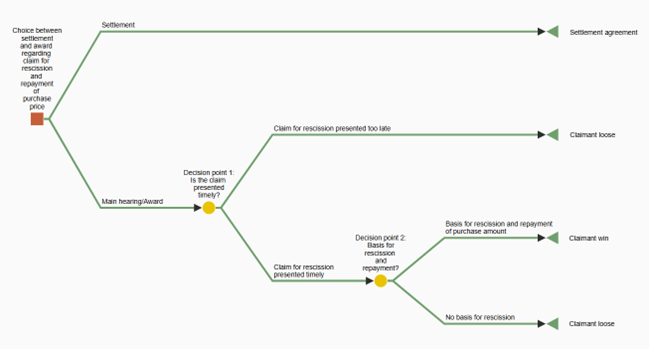
(Produced using dnodes.io)
In addition to mapping out a) to c) mentioned above, the decision tree can be used as a framework for:
i) structured assessments of the pros and cons of each decision point (legal issue),
ii) assessment of the likely outcome, expressed in percentages, for each decision point (legal issue), and
iii) calculation of the Expected Value of the disputed claim or claims.
The main use of decision trees in Arbitration 3.0 is in connection with potential mediation, a subsequent main-hearing, and the tribunal’s determination of the dispute. When used correctly, a decision tree provides the relevant participants with a visual one-pager that conveys «more than a thousand words». The use of decision trees is recommended by the ICC in its publication “Effective Conflict Management” (2023), pp. 42-43, and in Sverre Blandhol, «Kontraktsforhandlinger og forliksforhandlinger» (2024), pp. 102 – 127). See also an interview with Christian Hauge in Advokatbladet on the topic as well as the summary of Jan-Ole Hesselberg’s keynote, «Biases in risk assessments and how decision trees will help», delivered during Wiersholm’s pre-event to NAD in February 2025, see here.
We label the «mandatory» use of decision trees as «low-hanging». The concept is backed by science and easy to use because it simply underscores (visualises) how lawyers and arbitrators already think. The only real effort lies is implementing the use of a new tool, but that is a small price to pay given the benefits it offers. In our experience, the best digital platform for producing and using decision trees is dNodes.io, where it can be tried free of charge.
Proposal no. 4: Strict(er) rules on cost and sealed offer mechanisms.
The overriding goal of this proposal is to encourage more settlements by «empowering» rejected settlement offers which, in hindsight, should have been accepted when compared with the amount eventually awarded. The proposal is two-fold:
The first part is simple: introducing a clear rule that the arbitral tribunal, when deciding on the allocation of costs, «shall» consider whether a party has rejected a reasonable offer of settlement. Article 37 (1) of the NOMA Arbitration Rules (2024) explicitly states that, when deciding on the allocation of costs, the arbitral tribunal «shall» take into account whether a party has rejected a reasonable offer of settlement.
The second part is somewhat more complicated, but in its purest form still simple: a «sealed offer mechanism» is essentially an agreement or rule whereby a settlement offer that, if not accepted by the opposing party, is «sealed» and disclosed to the arbitral tribunal only after the award on the merits has been issued, when the time has come to determine the allocation of costs. Sealed offers are also referred to internationally as «Calderbank» offers, Part 36 offers, and «Without Prejudice Save as to Costs» offers. In the already mentioned ICC publication “Effective Conflict Management”, it is specifically highlighted that sealed offers “promote settlement by exerting pressure on the receiving party to consider settling, rather than risk incurring additional arbitration costs” (section 119 of the report).
The important point here is: for the strict cost rule to come into play, the arbitral tribunal must be made aware of any relevant rejected settlement offers. However, many parties are hesitant to disclose their settlement offers, fearing that doing so may influence the tribunal’s ultimate decision on the merits of the case. In our view, this concern is well founded in light of decision psychology. In a process involving sealed offer mechanisms, the party receiving a settlement offer must carefully consider the offer in light of the potential cost consequences of rejecting it. In other words: the counsel receiving a settlement offer must consider, and advise the client on, whether it is reasonable to expect a higher monetary recovery through an award, also taking into account future costs of obtaining that award.
We regard proposal no. 4 as «low- to mid-hanging». At the outset, it is straightforward to separate the tribunal’s decision on the merits from its decision on costs, revealing the sealed offer in between, together with a potential round of submissions on costs. However, and despite relative simplicity, we think it will take some time for this to develop into «best practice».
Proposal no. 5: Procedures to avoid decision-making pitfalls
Intuitively, and as supported by research, a three-member arbitral tribunal is more reliable than that of a single arbitrator. However, research also shows that all decisions made by a group – be it arbitral tribunals, courts, or a team of lawyers, run the risk of being influenced by collective thinking, confirmation bias and other pitfalls. See e.g. the article «Equal treatment is utopia» in Advokatbladet with further references to relevant research and articles (English version available here.)
The arbitral tribunal may have to decide on many issues and procedural disputes throughout the proceedings, including up to and during the main hearing. However, if the parties’ dispute is not resolved during the case preparations, the arbitral tribunal’s principal task is to decide on the merits of the case and render a final, enforceable award, including a decision on the allocation of costs.
The Norwegian Arbitration Act does not provide any guidance on how an arbitral tribunal should structure its decision-making process, and to our knowledge, no institutional rules address this issue. Consequently, it is largely left to the tribunal, and in particular the chairperson, to consider whether the decision-making process should be structured to avoid the pitfalls of collective thinking and to ensure that all relevant arguments and perspectives are taken into account when deciding on the merits of the case in accordance with applicable law, cf. section 31 of the Norwegian Arbitration Act.
Once the arbitral tribunal has heard all the evidence and must decide the case on its merits, we believe that the following measures should be implemented to avoid the pitfalls of collective thinking and to ensure the most accurate award possible:
First, the tribunal’s initial discussions should focus on identifying all the main arguments for and against each of the principal decision points in the case. At this stage, there should be no discussion of conclusions as to what the individual arbitrators consider to be the correct outcome on the various principal decision points. If there are disagreements within the tribunal as to what the principal decision points are, that issue should evidently be established first. As discussed under proposal no. 3, decision trees should be used.
As a second step, each member of the tribunal should individually assess what they believe is the correct outcome for each principal decision point. The arbitrators’ individual views should be recorded in writing in preparation for the third and final step. As an optional additional exercise, each arbitration may also record their degree of confidence in the outcome on each decision point by assigning a percentage.
As a third and final step, the tribunal should meet to decide on the merits of the case. At this stage, the chairperson should seek to facilitate a structured discussion in which the least senior member of the tribunal presents his/her view first, in order to reduce the risk of authority bias (Nw: autoritetsfellen). This is in line with the system used in both the Swedish and Danish Supreme Courts. Following an initial round in which each arbitrator has presented his or her view, it is, in our opinion, difficult to provide much more specific guidance on how the discussions should be organised before the tribunal reaches its final conclusions.
Despite the scientific support for this proposal, and although the suggested procedures should be easy to implement in practice, we regard this proposal as «mid/high hanging». The reason is that it will take time for awareness of pitfalls such as confirmation bias and group think to take hold within the arbitration community. Awareness alone does not produce change, and it will therefore also take time before specific action is taken. However, if this proves to be a competitive advantage over the ordinary courts, it may spark initiatives that lead to faster implementation than we currently anticipate.
Proposal no. 6: Preliminary (non-binding) views (the «German approach»)
In German ordinary courts, the following rule applies, cf. section 278 (1) of the German Code of Civil Procedure («ZPO»):
“In all circumstances of the proceedings, the court is to act in the interests of arriving at an amicable resolution of the legal dispute or of the individual points at issue.”
Pursuant to this provision, judges identify the key facts and legal issues and present the parties with a preliminary, non-binding assessment. This approach facilitates constructive dialogue and encourages settlements. The German Constitutional Court has emphasised that, even in a state governed by the rule of law, it is generally preferable to resolve an initially contentious issue by mutual agreement rather than by judicial decision (DIS Rules Clinic Report on Settlement Facilitation, 2025, paragraph 4).
In German arbitration, article 26 of the DIS 2018 Arbitration Rules echoes section 278 (1) of the ZPO, and reads as follows under the heading «Encouraging Amicable Settlements» :
“Unless any party objects thereto, the arbitral tribunal shall, at every stage of the arbitration, seek to encourage an amicable settlement of the dispute or of individual disputed issues.”
Also, Annex 3 to the DIS Rules, item F, sets out the following suggested measure to increase procedural efficiency:
«Providing the parties with a preliminary non-binding assessment of factual or legal issues in the arbitration, provided all of the parties consent thereto.»
For further insight into the «German approach», we refer to the DIS Rules Clinic Report on Settlement Facilitation (2025) and to a conversation with Hans-Patrick Schröder, partner at Freshfields (Hamburg) in episode 3 of Woldgiftspodden.
Inspired by the German approach, our proposal no. 6 for Arbitration 3.0 is as follows:
The arbitral tribunal shall, subject to the parties’ consent, provide a written preliminary, non-binding view on parts of the dispute or on the dispute as a whole, based on the material presented to them. Preferably, that written preliminary, non-binding view should include a decision tree identifying the dispute’s key legal issues, without expressing any conclusions as to the outcome (cf. proposal no. 3).
To tackle the bull by the horns: this proposal is undoubtedly (very) «high-hanging» (some may say unrealistically so). We recognise that the proposal is controversial in light of current Norwegian and Nordic arbitration traditions. However, in our view, those traditions rest on an erroneous assumption on how the mind works:
The current prevailing view is that, when a judge or arbitrator expresses a preliminary view, he or she thereby becomes biased in favour of one of the parties. Consequently, it could/would be argued that an arbitrator who has expressed a view on the merits of the dispute should no longer be considered «impartial», cf. section 13 (1) of the Norwegian Arbitration Act.
However, decision-making psychology suggests that the mind cannot avoid automatically forming views and opinions. This is particularly true of judges and arbitrators, whose (paid) role is ultimately to adjudicate. Accordingly, expressing a preliminary view does not materially alter what is already taking place in the arbitrator’s mind. This view is based on what we have learned through our cooperation with psychologist and decision-making researcher Jan-Ole Hesselberg, who further elaborates on this in episode 3 of Woldgiftspodden.
Put differently: if proposal no. 6 were implemented in Norwegian arbitration in accordance with the German approach, the only real difference from the current position would be that the parties would gain insight into «the black box» (the arbitrator’s brain) and, accordingly, an opportunity to persuade the arbitrator before it is too late. Moreover, and equally important, preliminary views can also facilitate settlements and streamline the arbitration proceedings if no settlement is reached.
Inspired by Vibeke Groth’s story (see above) on how court-led mediation, after countering considerable resistance, ultimately became incorporated into Norwegian law and proved highly successful, we invite you to approach this potentially game-changing development in Norwegian arbitration with an open mind and to join us in a constructive debate.
NAA News
On 5 February, the annual Norwegian Arbitration Day was held in Gamle Festsal at the University of Oslo, bringing together the Nordic arbitration community for a day of reflection and valuable insights through two panel discussions.
The first panel, moderated by Jonas Rosengren of WERKS Law Firm, examined the challenges of arbitral awards from the courts’ perspective. He was joined by Are Stenvik, Johnny Herre, and René Offersen, each of whom shared valuable perspectives drawn from their extensive experience.
The second panel addressed the highly relevant topic of arbitration and ordre public. Keynote speaker Giuditta Cordero Moss was joined by Aadne Haga, Hanne Aarsheim, Shirin Saif, and Petri Taivalkoski for an engaging discussion that drew on both the theoretical framework and their practical experience with the issue.
In addition to the main event at Gamle Festsal, both Wiersholm and BAHR successfully hosted pre-events at their own premises, continuing a well-established tradition.
At BAHR’s event, the discussion focused on whether the time has come to revise the Norwegian Arbitration Act, particularly in light of recent reforms to arbitration legislation in England and Singapore. The general consensus was that certain amendments would be desirable in order to keep pace with current developments while preserving the defining characteristics of a Model Law jurisdiction.
Wiersholm invited guests to explore the topic of confirmation bias in arbitration, bringing together perspectives from law and psychology. Psychologist Jan-Ole Hesselberg introduced the topic through engaging examples and exercises illustrating how the brain works when making decisions, followed by a panel discussion on the subject, see more here.
NOMA News
In our Q3 2025 Newsletter, we reported on the NOMA Award in the «Heroic Idun» case, dated 5 August 2025, which addresses questions on war risk cover under the Nordic Marine Insurance Plan.
NOMA has now published an anonymised version of the award, see here.
NOMA has also announced that it will make available relevant anonymised versions of the Procedural Orders from the case. We will report on these once published.
What’s On the Agenda
Decision by the Norwegian Supreme Court – A surety without a written arbitration clause was not subject to arbitration
In a decision dated 15 April 2026 (HR-2026-055-U), the Norwegian Supreme Court considered whether a lawsuit should be dismissed because the parties had agreed that the dispute was subject to arbitration.
In October 2019, Westcon Yards AS and Rimfrost Antarctic AS entered into a shipbuilding contract containing an arbitration clause. Two months later, Westcon Yards’ contractual rights and obligations under the contract were transferred to Westcon 39 AS by way of an addendum to the shipbuilding contract. In this connection, Rimfrost Antarctic’s parent company, Rimfrost Holding AS, issued a surety (Nw: selvskyldnerkausjon) for Rimfrost Antarctic’s obligations under the shipbuilding contract. The surety did not contain an arbitration clause.
Westcon 39 later terminated the shipbuilding contract and commenced arbitration proceedings against Rimfrost Antarctic. In June 2025, Westcon 39 also brought proceedings before the ordinary courts against Rimfrost Holding, seeking NOK 117 million under the surety. Rimfrost Holding argued that the claim should be dismissed because the dispute was subject to arbitration. The lower courts agreed, but the Norwegian Supreme Court reached the opposite conclusion.
Under section 7 of the Norwegian Arbitration Act, the ordinary courts must dismiss proceedings that are subject to arbitration, provided that dismissal is requested no later than in the respondent’s first submission on the merits. Such dismissal presupposes that the parties have entered into an arbitration agreement covering the dispute, see section 10 of the Norwegian Arbitration Act.
The Norwegian Supreme Court emphasised that whether the parties have de facto entered into an arbitration agreement must be determined on the basis of general principles of contract law. However, since an arbitration agreement in essence entails a waiver of the right to have a dispute heard by the ordinary courts, the threshold for concluding that an arbitration agreement has been entered into is high.
The Supreme Court first noted that there was no written arbitration agreement between Westcon 39 and Rimfrost Holding. The shipbuilding contract containing the arbitration clause had been concluded between Westcon Yards and Rimfrost Antarctic, and Rimfrost Holding was not a party to that agreement. Nor did the surety issued by Rimfrost Holding contain an arbitration clause.
In the absence of a written arbitration agreement between the parties, the Supreme Court considered whether there was a mutual understanding that disputes under the surety were also subject to arbitration. The Court of Appeal had emphasised that Rimfrost Holding was Rimfrost Antarctic’s parent company, that the agreements had been entered into with the involvement of individuals with an overall view of the contractual structure, and that there was an interest in consolidated and efficient dispute resolution. The Supreme Court held that these factors were insufficient to establish that the parties had agreed to arbitrate disputes under the surety. The Court of Appeal’s decision was therefore set aside.
The Norwegian Supreme Court’s decision underscores the importance of including a written arbitration clause in commercial agreements. In the absence of a clear written agreement, it will be difficult to argue that the parties have agreed that any dispute is subject to arbitration.
Frostating Court of Appeal’s decision clarifies when arbitration objections must be raised and what constitutes an arbitration agreement
In a decision issued 25 February 2026 (LF-2026-20373), Frostating Court of Appeal considered (i) whether an expert determination clause in an IT agreement constitutes an arbitration agreement, and (ii) at what stage of the court proceedings a party must raise an objection that the dispute belongs in arbitration.
On the timing issue, the Court of Appeal held that the party asserting that the claim was subject to arbitration had raised the objection too late. In this case, the claims were introduced in written submissions. In its first response, the party opposed the claims and briefly addressed the merits of the case but failed to assert that the claims should be subject to arbitration. The Court of Appeal relied extensively on the Supreme Court’s decision in HR-2023-2055-A and concluded, in substance, that “an unreasoned rejection of the claim that has been advanced is sufficient to be considered as having engaged with the merits of the case” in accordance with section 7 of the Arbitration Act.
The Court of Appeal also endorsed the District Court’s assessment that the agreement’s expert determination clause, which stated that “all disputes shall first be solved by an expert determination…”, did not amount to an arbitration agreement. The District Court supported this conclusion by noting that the parties are not free to impose whatever preconditions they wish on access to the ordinary courts, and that any limitation on access to the courts must have a statutory basis.
The specific assessment emphasised that, by its nature, the agreed expert determination mechanism was not a “final and unchallengeable” decision of the kind that produces effects under section 45 of the Norwegian Arbitration Act. This view is consistent with discussions in legal scholarship and with the Supreme Court’s approach in HR-1999-493-K , which indicates that parties have limited scope to impose mandatory negotiations and written decision-making mechanisms as preconditions that must be exhausted before a dispute may be brought before the ordinary courts.
Episode 3 of Woldgiftspodden is out
In episode 3 of Woldgiftspodden, «My mind is open, but not empty», we explore preliminary, non-binding views from arbitral tribunals in international commercial arbitration.
What if, after the exchange of the statement of claim and defence, the arbitrators invited the parties to receive a preliminary, non-binding view of how the case stands? This is an uncommon approach in Norway, but in Germany it is an integrated part of disputes proceedings before the ordinary courts and, if the parties agree, in arbitration as well.
First, we speak with Patrick Schroeder about how this works in practice in Germany.
Second, we get Aadne M. Haga’s (mixed) experiences and views on this from a Norwegian perspective.
Third, psychologist Jan-Ole Hesselberg gives us insight into the psychological effects of providing a preliminary, non-binding view.
A link to the full episode can be found here.
***
There are many events to choose from on the international commercial arbitration scene. We recommend the following upcoming happenings:
- 7 – 8 May 2026: Nordic Arbitration Day in Stockholm for arbitration practitioners aged 45 or younger from Sweden, Finland, Denmark, Norway and Iceland.
- 25 – 27 June 2026: Annual International Arbitration Conference – «Limits and obstacles to arbitration» in Helsinki
- 10 – 11 September 2026: Swedish Arbitration Days – Save the date
- 1 – 2 October 2026: Copenhagen Arbitration Day 2026 – Save the date
- 29 October 2026: NOMA-Day in Bergen – Save the date
Read our newsletter from 2025 here:
Kontaktpersoner




Publisert: